COUCHBASE SUMMER RELEASE
One Governed Data Layer for Production AI Agents
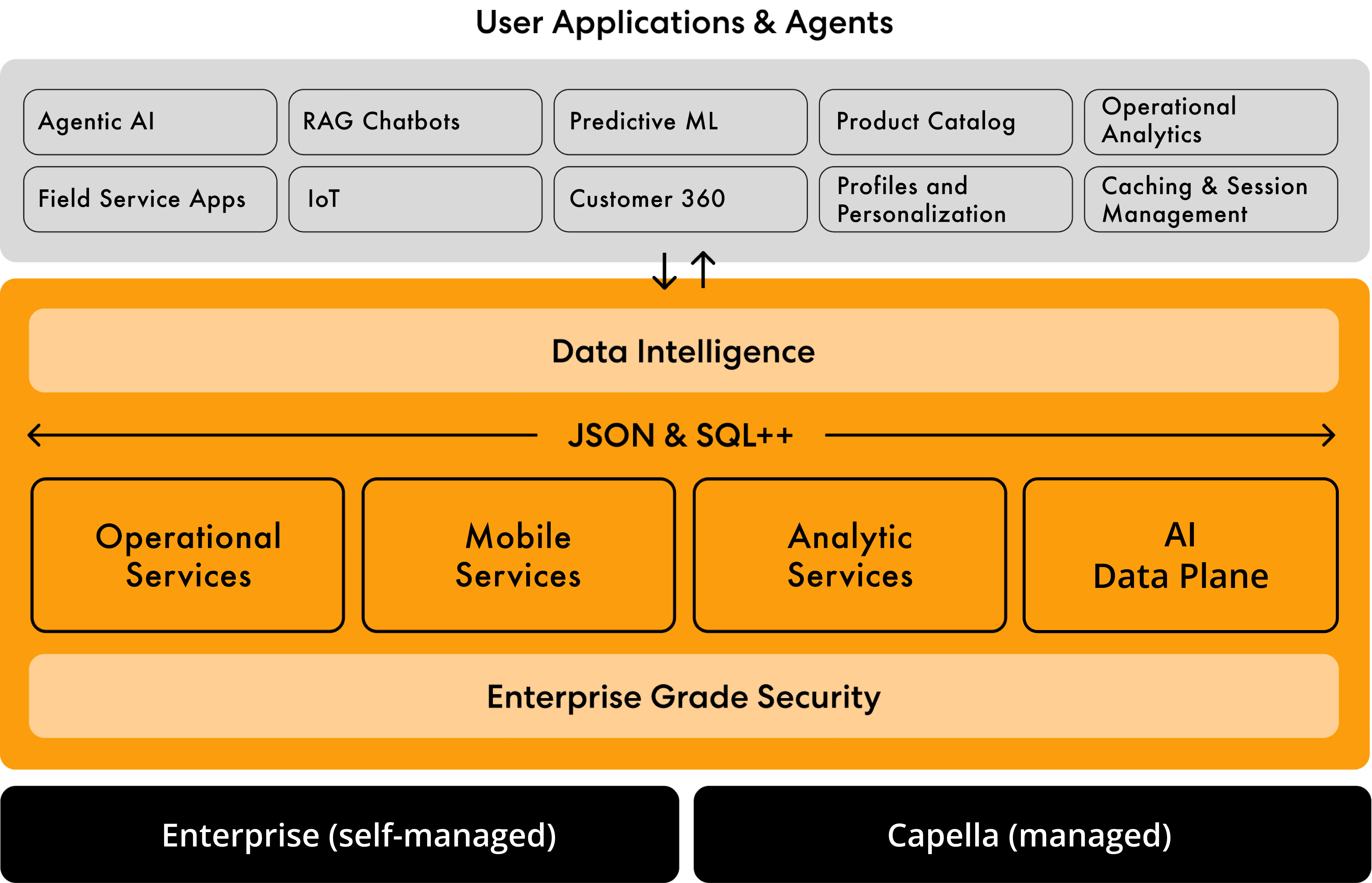
Couchbase AI Data Plane™ gives production AI agents persistent memory, governed data access, and fast context retrieval across cloud, self-managed, hybrid, edge, and lakehouse environments.
82.3%
Agent Memory score on the LoCoMo benchmark
94%
recall on LongMemEval-M single session
69.4%
Overall score on LongMemEval-S
Also in this release
Advancements in key Couchbase Operational Data Platform features.

Capella iQ multi-model
Choose AWS Bedrock or OpenAI, governed by org-level provider policies.
Agent Catalog
Now an enterprise-supported component for discoverable, governed agent tooling.
Sync Gateway 4.1
Rolling upgrades, faster large-dataset resync, and system metadata isolation.
Edge Server 1.1
Client-level access control, CORS, credential rotation, and Windows/ARM support.
Azure XDCR over Private Link
Cross data center replication over private connectivity, off the public internet.
MCP Server
Enterprise-supported, self-managed MCP server for standardized Model Context Protocol integration.
One governed data layer for AI and agents
Production agents need memory, tools, prompts, operational data, traces, and context, but those assets often live in scattered systems. Couchbase keeps them in one governed data layer, giving teams visibility into what an agent used, which prompt version was involved, and what data shaped the response.
Inspect agent behavior
Keep prompts, tools, traces, memory, and operational data together and query them with SQL++ to see exactly what an agent used and why it responded.
Standardized data access
The Couchbase MCP Server gives agents standardized access to operational data, documents, and cache without a separate integration tier.
Reusable across teams
Agent Catalog makes prompts, tools, and end-to-end traces discoverable so teams can inspect, reuse, and govern agent behavior across applications.
Framework-agnostic memory
Agent Memory works across LangGraph, CrewAI, and LlamaIndex, so teams can switch or combine frameworks without rebuilding memory infrastructure.

What customers are saying
-


“As we’ve scaled into agentic workloads, this was a natural extension to our partnership.”
Patrick Ferriter, SVP of Product, Agora0.5
second agentic transaction target
4
real work agentic AI use cases
-

“What Couchbase has done with SQL++ has been one of the most innovative things done in the database space in decades.”
Bill House, VP of Engineering, SWARM Engineering400%
faster planning
$1M+
savings per optimization
-


“Couchbase is a highly scalable, distributed data store that plays a critical role in LinkedIn’s systems.”
Michael Kehoe, Senior Staff Site Reliability Engineer, LinkedIn10M+
queries per second
<4MS
avg latency for 2.5+ billion items
Want to learn more?
Webcast: Your Agents Are Smart. Your Data Layer Isn’t Ready.
In this webcast and demo, we’ll show you how to ensure your AI agent doesn’t join the graveyard of pilots that never ship.
You’ll learn how:
- AI Data Plane unifies memory, governed data access, and agent observability into one layer
- Agent Memory gives agents persistent recall, making them smarter and more personalized over time
- Agent Catalog, with agentic app tracing, makes every prompt, tool call, and decision inspectable and auditable
Blog: Your AI Agents Are Stuck in Pilot. It’s a Data Problem, Not a Model Problem.
Learn why enterprise AI initiatives routinely stall in the pilot phase due to foundational data challenges.
- Discover how the Couchbase AI Data Plane collapses scattered data services into a single governed layer running natively across cloud, self-managed, and edge architectures.
- Deep dive into the three pillars making production-grade agents possible: framework-agnostic Agent Memory, standards-based MCP Server data connectivity, and an auditable Agent Catalog.
- Find out how integrating semantic caching at the data layer slashes response times and controls costs.
Agent Memory Trial
Try Agent Memory and see how AI agents can retain context across sessions, users, and frameworks, while reducing custom memory, retrieval, and access-control logic.